Intro

Note: This feature is in beta. Contact your Domo account team to join.
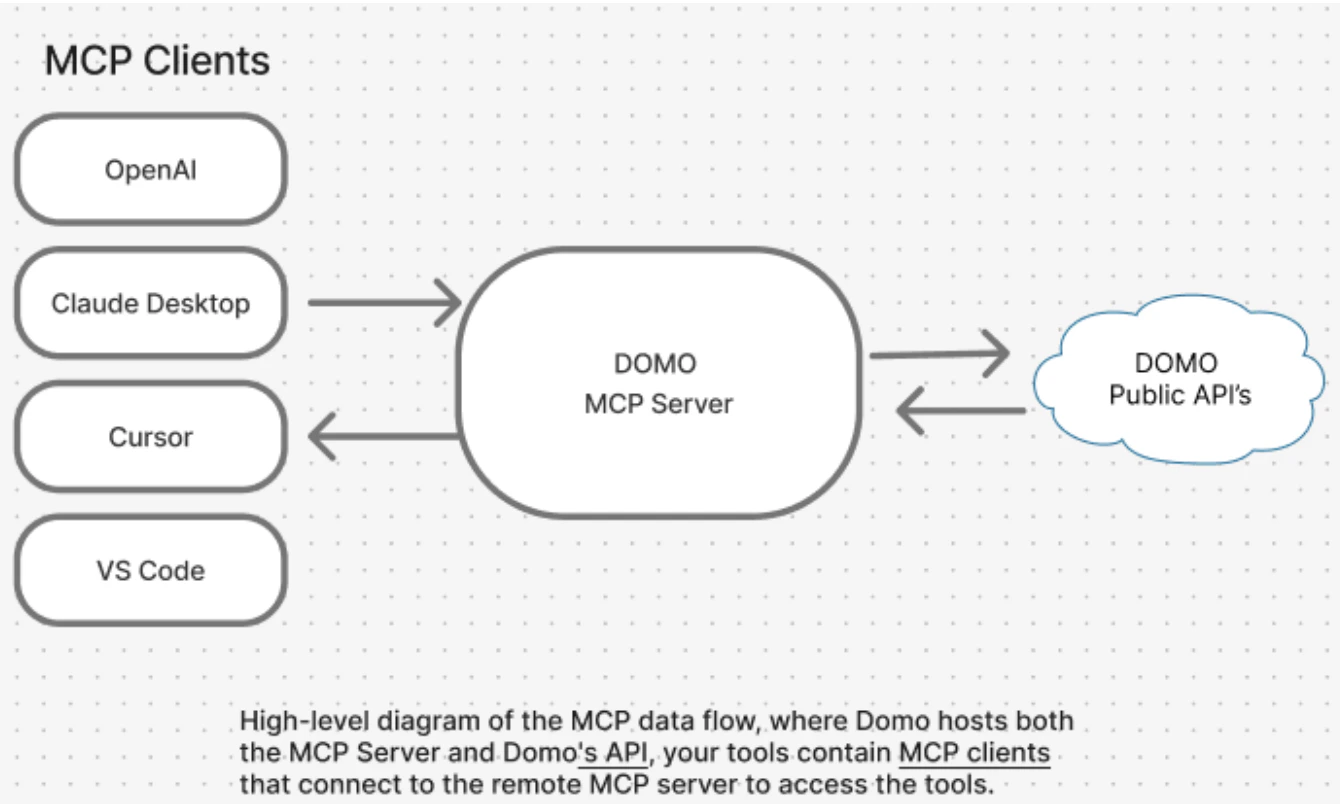
The Model Context Protocol (MCP) is an open standard that allows AI assistants to securely interact with external platforms and data sources. Domo’s MCP Server is a hosted service that gives AI tools — such as Claude, Cursor, VS Code, and ChatGPT — secure access to your Domo instance. Once connected, you can use your AI tool to:
  • Query data in your Domo DataSets
  • Query documents stored in Domo
  • Search across your Domo instance
  • Summarize cards and pages (coming soon)
This article walks through how to connect Claude Desktop, Claude Code, or VS Code to the Domo MCP Server and verify your connection.

Prerequisites

Before connecting, ensure you have the following:
  • Node.js version 21 or higher installed. Use nvm to manage your Node.js version.
  • A Domo Access Token with appropriate permissions. You can provision one at Admin > Authentication > Access Tokens, or request one from your MajorDomo. See Manage Access Tokens for instructions.
  • A supported AI code editor (Claude Desktop, Claude Code, VS Code, Cursor, or another MCP-compatible client).

Connecting Claude Desktop

Claude Desktop does not natively support remote MCP servers, so you connect using mcp-remote — an NPM tool that bridges desktop AI clients to remote MCP servers.

Step 1: Provision an Access Token

In your Domo instance, go to Admin > Authentication > Access Tokens and generate a token. See Manage Access Tokens for instructions.

Step 2: Install mcp-remote

Open a terminal and run:
npm install mcp-remote

Step 3: Install Claude Desktop

Download and install Claude Desktop.

Step 4: Edit the Claude Desktop configuration

In Claude Desktop, go to Settings > Developer and select Edit Config.
This opens the configuration file located at:
/Users/<username>/Library/Application Support/Claude/claude_desktop_config.json

Step 5: Add the Domo MCP Server configuration

Paste the following into the configuration file, replacing <DOMO_DOMAIN> with your Domo instance domain and <DOMO_ACCESS_TOKEN> with your Access Token:
{
  "mcpServers": {
    "domo-mcp-npx": {
      "command": "npx",
      "args": [
        "mcp-remote",
        "https://<DOMO_DOMAIN>/api/ai/v1/assistant/mcp/toolkits/DOMO_BASIC_MCP",
        "--header",
        "X-DOMO-DEVELOPER-TOKEN:<DOMO_ACCESS_TOKEN>"
      ]
    }
  }
}

Step 6: Restart Claude Desktop

Quit and restart Claude Desktop for the configuration to take effect.

Step 7: Verify the connection

Go to Settings > Connectors and confirm the Domo MCP server is listed and connected.
Select the server to view its tool permissions. You should see the following tools listed:
  • DomoSqlQueryTool
  • ExtendedThinkingTool
  • FileSetQueryTool
  • SearchTool
To test the connection, try a prompt such as: “How many datasets do I have access to?”

Connecting Claude Code

In Claude Code, run the following command from the root of your project. Replace <DOMO_DOMAIN> with your Domo instance domain and <DOMO_ACCESS_TOKEN> with your Access Token:
claude mcp add --transport http secure-api \
  https://<DOMO_DOMAIN>/api/ai/v1/assistant/mcp/toolkits/DOMO_BASIC_MCP \
  --header "X-DOMO-DEVELOPER-TOKEN: <DOMO_ACCESS_TOKEN>"
This adds the configuration to a .mcp file in the root of your project:
{
  "mcpServers": {
    "domo-mcp": {
      "type": "http",
      "url": "https://<DOMO_DOMAIN>/api/ai/v1/assistant/mcp/toolkits/DOMO_BASIC_MCP",
      "headers": {
        "X-DOMO-DEVELOPER-TOKEN": "<DOMO_ACCESS_TOKEN>"
      }
    }
  }
}

Connecting VS Code

  1. Open the Command Palette with Cmd+Shift+P (Mac) or Ctrl+Shift+P (Windows/Linux).
  2. Choose your configuration scope:
    • For a global configuration available across all workspaces, search for and select MCP: Open User Configuration.
    • For a workspace-specific configuration (recommended for sharing within a project), search for and select MCP: Open Workspace Folder MCP Configuration. This creates or opens .vscode/mcp.json.
  3. Add the following entry to the servers object in the configuration file. Replace <DOMO_DOMAIN> with your Domo instance domain and <DOMO_ACCESS_TOKEN> with your Access Token:
    {
      "servers": {
        "domo-mcp": {
          "type": "http",
          "uri": "https://<DOMO_DOMAIN>/api/ai/v1/assistant/mcp/toolkits/DOMO_BASIC_MCP",
          "headers": {
            "X-DOMO-DEVELOPER-TOKEN": "<DOMO_ACCESS_TOKEN>"
          },
          "version": "1.0.0"
        }
      }
    }
    

Troubleshooting

Depending on your environment, you may need to make additional changes to the Claude Desktop configuration. Mac If npx cannot be found, add an env property to the domo-mcp-npx server entry in your configuration, replacing <USER_PATH> with your home directory path:
"env": {
  "PATH": "<USER_PATH>/.nvm/versions/node/v22.21.1/bin:/usr/local/bin:/usr/bin:/bin"
}
Windows If npx cannot be found, replace the "command" value in your configuration with the full path to the npx executable:
"command": "C:\\Program Files\\nodejs\\npx.cmd"

FAQ

The Domo MCP Server works with any MCP-compatible AI client, including Claude Desktop, Claude Code, VS Code, Cursor, and ChatGPT.
Once connected, you can query your Domo DataSets, query documents stored in Domo, and search across your Domo instance. Card and page summarization are coming soon.